


EV reliability and real-world range in India 2025 are now key purchase factors, with brands like Tesla and BMW outperforming claimed range figures and boosting buyer confidence in electric vehicles.

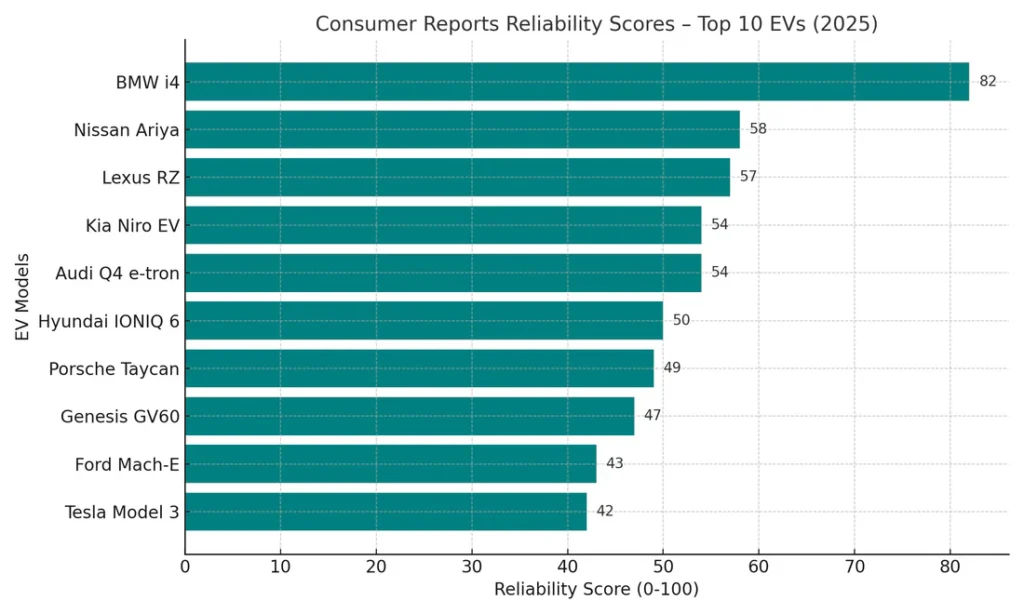
Electric vehicles are no longer futuristic concepts — they are present-day realities redefining mobility. However, as EV adoption increases, buyer priorities have evolved. Earlier, the excitement around EVs centered on tax benefits, tech features, and silent drives. But now, one question dominates every purchase decision:
“Can I trust an EV for long-term reliability and real-world range?”
The EV reliability and real-world range discussion has become central because Indian consumers don’t just evaluate brochure numbers — they need performance in everyday conditions: summer heat, highway runs, traffic jams, and unexpected detours.
In 2025, EV reliability has moved from speculation to proven fact — thanks to Tesla entering the Indian radar, BMW’s real-world dominance, and domestic brands improving battery ecosystems. The shift is not merely mechanical — it’s psychological.
Why EV Reliability Matters More Than Ever
Unlike petrol or diesel engines, EVs depend primarily on:
- Battery quality
- Charging architecture
- Power electronics
- Software reliability
This means an EV isn’t judged just on horsepower — it is judged on engineering trust.
For Indian consumers, reliability includes:
✔️ No sudden battery drops
✔️ Predictable charging behavior
✔️ Accurate range estimates
✔️ Low maintenance cost
EVs that fail in these aspects lose customer loyalty instantly — because EV buyers are educated, digitally connected, and comparison-driven.
Real-World Range vs. Claimed Range — Why They Differ
Every EV manufacturer highlights a bold mileage figure — but most buyers know these are ideal numbers achieved under controlled lab tests.
Real-world range varies based on:
| Influence Factor | Effect |
|---|---|
| Temperature | Heat reduces battery efficiency |
| Driving Style | Hard acceleration = faster drain |
| Payload | More luggage/passengers = less range |
| Speed | Constant highway speeds drain faster |
| Terrain | Steep climbs consume more power |
This is exactly why buyers now demand proven range, not promised range.
Tesla’s Reliability Impact
Tesla’s entry into India — even before mass sales begin — has dramatically reshaped EV perception.
Tesla’s Reliability Reputation
Tesla models routinely outperform claimed ranges in multiple countries thanks to:
- Mature battery management software
- Effective thermal control systems
- Continuous OTA optimizations
Tesla has turned EVs into software platforms — not static machines.
For Indian EV makers, Tesla sets the benchmark: performance must improve over time, not degrade.
BMW iX3: The Range Leader
One of the biggest headlines of 2025 was the BMW iX3 exceeding its official range in real-world tests.
Why BMW Is Winning
- Efficient motor tuning
- Highly optimized regen braking
- Intelligent power usage mapping
The BMW iX3 story proved this:
EV range anxiety is not a technology problem — it’s a brand execution problem.
India’s Homegrown EV Brands: Trust Building On Ground
Tata Motors, MG, and Mahindra have played a critical role in:
- Localizing EV components
- Reducing charging costs
- Offering real-time telematics
- Educating consumers
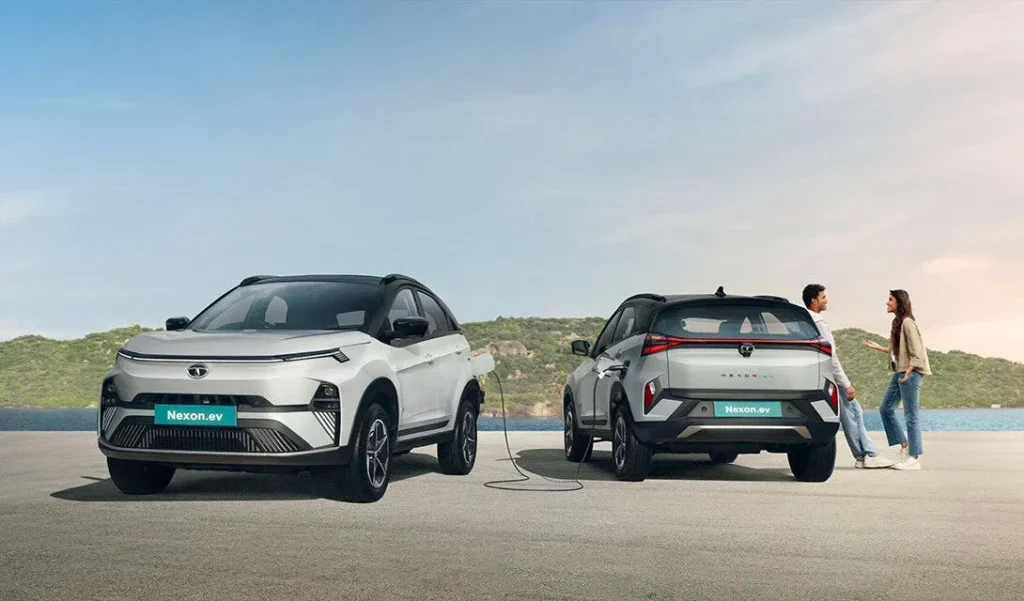
Tata’s EVs — Nexon EV, Punch EV, and Tiago EV — have created trust through:
✔️ City-friendly range
✔️ Fast-charging expansion
✔️ Affordable ownership
✔️ Improved service experience
They proved an EV doesn’t have to be expensive to be dependable.
Factors Improving EV Reliability in 2025
1️⃣ Better Battery Management Systems
Modern BMS prevents:
- Overcharging
- Deep discharge
- Thermal runaway
2️⃣ Predictive Analytics
Cars now warn users before problems occur.
3️⃣ OTA (Over-The-Air) Updates
Software enhancements improve range without visiting a service center — unimaginable in fuel cars.
4️⃣ Public Charging Infrastructure
Availability reduces anxiety because:
- You don’t fear running out
- Long trips become feasible
5️⃣ Component Localization
Spare parts costs dropping = long-term trust rising
The EV Reliability Paradox
EVs have fewer moving parts than ICE vehicles, meaning:
🚫 no oil changes
🚫 no radiator worries
🚫 no gearbox failures
Yet mental resistance remains because EV ownership is new. Indians don’t mistrust the machine — they mistrust the unknown.
This is changing rapidly.
How Real-World Range Will Decide EV Winners
Brands with strong range performance will dominate because:
- Consumers want predictability
- Real usage > showroom promises
- Range confidence = purchase confidence
The next EV war won’t be about:
⚡ Acceleration
⚡ Screens
⚡ Charging speed
It will be about reliability under pressure.
EV Customer Priorities Entering 2026
| Priority | Importance |
|---|---|
| Range accuracy | Very High |
| Charging access | Essential |
| Battery warranty | Critical |
| Service ecosystem | Must-have |
| Tech support | Differentiator |
The industry is moving from excitement to expectation — and expectation to demand.
Conclusion
The conversation around EV reliability and real-world range has fundamentally changed the automotive landscape in India. EVs are no longer purchased as eco-status symbols; they are becoming primary family vehicles.
What once began as curiosity has evolved into trust — and trust is the strongest currency in the automotive world.
The winners of India’s EV revolution will be companies that offer:
✔️ Real range
✔️ Proven dependability
✔️ Intelligent energy management
✔️ Transparent ownership experience
In short:
The future belongs not to the fastest EV — but the most reliable one.